trees <- tibble::tibble(
  DBH = c(18, 22, 30, 26, 20),
  height = c(15, 18, 22, 20, 20),
  species = c("PICE.MAR", "BETU.PAP", "POPU.TRE", "PSEU.MEN", "PINU.BAN"),
  jurisdiction =  c("AB", "ON", "QC", "BC", "MB"),
  subregion = c(NA, NA, NA, "CWH", "Boreal Plains")
)

trees |>
  dplyr::mutate(
    vol(
      DBH = DBH,
      height = height,
      species = species,
      jurisdiction = jurisdiction,
      subregion = subregion,
      keep_model_id = TRUE
    )
  )
#> # A tibble: 5 × 8
#>     DBH height species  jurisdiction subregion     vol_total vol_merchantable
#>   <dbl>  <dbl> <chr>    <chr>        <chr>             <dbl>            <dbl>
#> 1    18     15 PICE.MAR AB           <NA>              0.158            0.145
#> 2    22     18 BETU.PAP ON           <NA>              0.291            0.233
#> 3    30     22 POPU.TRE QC           <NA>             NA                0.674
#> 4    26     20 PSEU.MEN BC           CWH               0.387            0.305
#> 5    20     20 PINU.BAN MB           Boreal Plains     0.291            0.274
#> # ℹ 1 more variable: vol_model <chr>Tree volume models included in the package
There are several individual tree volume allometric models designed for Canadian forests. Most were developed at the jurisdiction level and require DBH, height, and species as inputs.
The package currently includes:
-
vol_fortin2007(). Provincial merchantable volume model for Quebec. Coverage: QC. 26 species. Fortin et al. (2007) -
vol_galbella94(). Provincial taper model for Saskatchewan based on the Kozak variable-exponent form. Coverage: SK. 12 species. Gál and Bella (1994) -
vol_honer83(). Regional volume models for central and eastern Canada, applicable across multiple provinces. Coverage: NB, NL, NS, ON, PE, QC. 21 species. Honer et al. (1983) -
vol_huang94(). Provincial taper model for Alberta based on the Kozak variable-exponent form; applicable at the province level or by Alberta subregions. Coverage: AB. 13 species. Huang et al. (1994) -
vol_klos2007(). Provincial taper model for Manitoba based on the Kozak variable-exponent form; applicable at the province level or by ecozone. Coverage: MB. 5 species. Klos et al. (2007) -
vol_kozak94(). Provincial taper model for British Columbia; requires BEC zone as a subregion input. Coverage: BC. 16 species. Kozak (1994) -
vol_nigh2016(). Total and merchantable volume equations for BC. Coverage: BC. 18 species. Nigh (2016) -
vol_nl(). Total and merchantable volume for Newfoundland and Labrador. Coverage: NL. 12 species. Honer (1967); Ker (1974); Warren and Meades (1986) -
vol_sharma2021(). Regional volume models for central and eastern Canada, applicable across multiple provinces. Coverage: NB, NL, NS, ON, PE, QC. 25 species. Sharma (2021) -
vol_ung2013(). National taper model for Canada, available in two variants: DBH-only and DBH with total height. Coverage: Canada (national). 34 species. Ung et al. (2013) -
vol_zakrzewski2013(). Provincial taper model for Ontario. Coverage: ON. 24 species. Zakrzewski and Penner (2013)
vol(): automatic tree volume estimation across multiple models
vol() is a convenience wrapper for estimating total and merchantable tree volume using the volume models implemented in CanadaForestAllometry. Rather than requiring users to select a specific model, vol() uses the internal model registry and automatically determines which models are applicable for each tree based on:
- species availability in model parameter tables
- geographic scope (province/jurisdiction)
- required inputs (e.g. total height, subregion such as BEC zone)
- model ranking (regional models preferred over national where available)
Example:
Merchantability criteria
Merchantable volume in CanadaForestAllometry is defined using jurisdiction-specific merchantability rules, following the officially adopted criteria in each province or territory (e.g., minimum top diameter, minimum DBH, and stump height). For most models, these rules are applied dynamically based on the provided jurisdiction.
Some volume models, however, have merchantability criteria fixed within the model formulation itself, reflecting how the original equations were developed and calibrated. In these cases (e.g., vol_honer83(), vol_sharma2021(), vol_fortin2007(), vol_nigh2016()), merchantable volume is computed using the model-specific, hard-coded criteria and does not vary by jurisdiction or species.
The jurisdiction-specific merchantability criteria used by CanadaForestAllometry can be inspected in the built-in dataset merchcrit, which documents the values applied for each jurisdiction (and, where applicable, by species or subregion).
Comparing Tree Volume Models
Tree stem volume is estimated in Canada using a variety of model families, ranging from national equations (e.g., Ung et al. (2013)) to province-specific taper and volume systems (e.g., Kozak (1994), Huang et al. (1994), Zakrzewski and Penner (2013), Sharma (2021)). These models differ in their functional form, calibration data, and jurisdictional scope.
The CanadaForestAllometry package implements these models under a unified interface, allowing consistent input formatting and transparent model selection. However, different equations may yield systematically different predictions for the same tree dimensions.
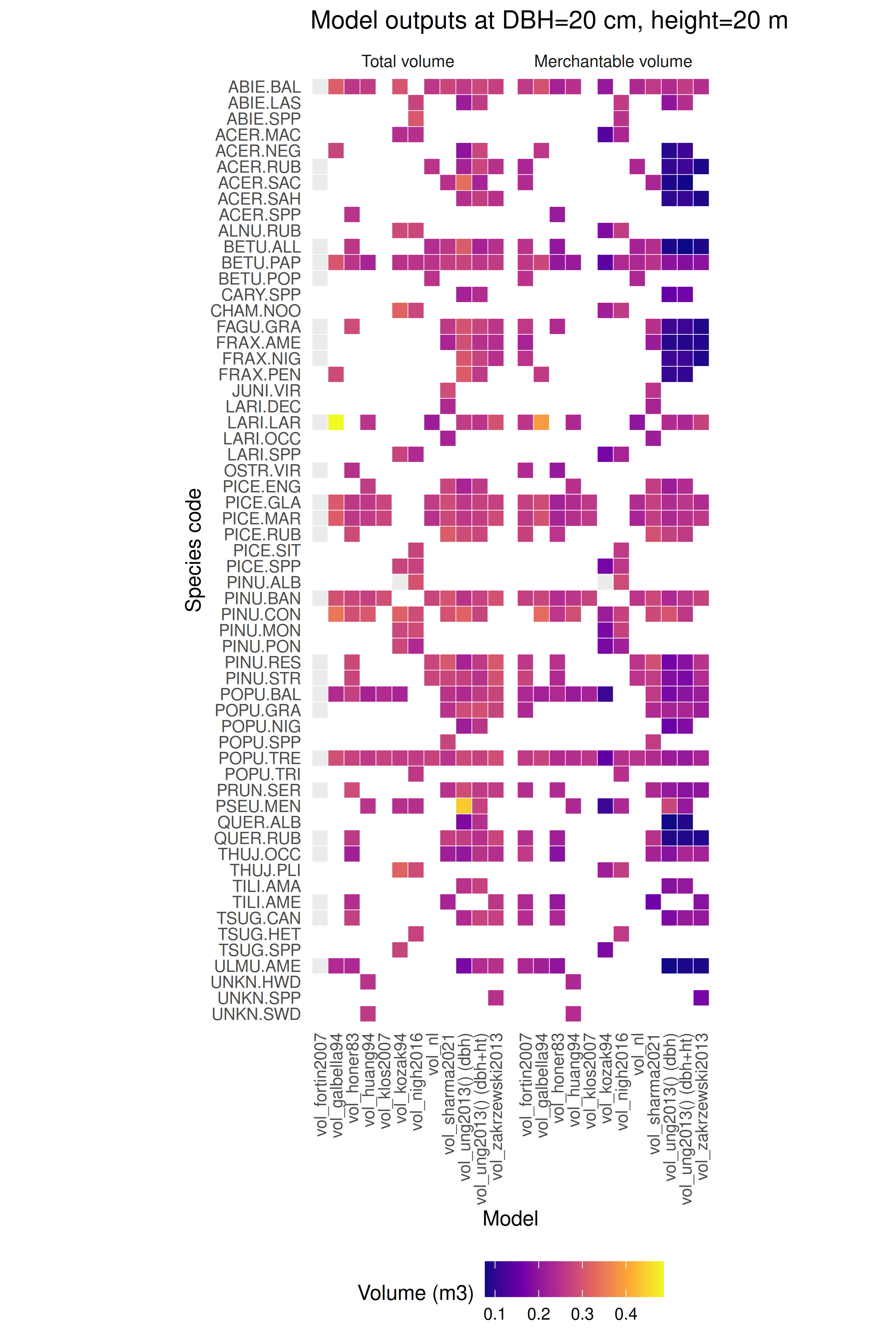
The figure below shows total and merchantable volume calculated using all implemented models (x-axis) across species. It provides a quick overview of species coverage (i.e., which species are covered by each model) and highlights differences among model outputs, with tree DBH and height held constant for every calculation.
References
Fortin, M., DeBlois, J., Bernier, S., Blais, G., 2007. Mise au point d’un tarif de cubage général pour les forêts québécoises : Une approche pour mieux Évaluer l’incertitude associée aux prévisions. The Forestry Chronicle 83, 754–765. https://doi.org/10.5558/tfc83754-5
Gál, J., Bella, I.E., 1994. New stem taper functions for 12 Saskatchewan timber species.
Honer, T.G., 1967. Standard volume tables and merchantable conversion factors (Information Report No. Information Report N-X-67). Canadian Forest Service, St. John’s, Newfoundland.
Honer, T.G., Ker, M.F., Alemdag, I.S., 1983. Metric timber tables for the commercial tree species of central and eastern Canada.
Huang, S., Titus, S., Lakusta, S., Held, R., 1994. Ecologically Based Individual Tree Volume Estimation for Major Alberta Tree Species, … to Alberta Environmental Protection, Land ….
Ker, M.F., 1974. Metric Tree Volume Tables for Newfoundland. Canadian Forest Service Information Report N-X-122.
Klos, R.J., Wang, G.G., Dang, Q.-L., East, E.W., 2007. Taper Equations for Five Major Commercial Tree Species in Manitoba, Canada. Western Journal of Applied Forestry 22, 163–170. https://doi.org/10.1093/wjaf/22.3.163
Kozak, A., 1994. Development of Taper Equations by BEC Zones and Species. Province of British Columbia, Ministry of Forests.
Nigh, G.D., 2016. Total and merchantable volume equations for common tree species in British Columbia: By region and biogeoclimactic zone (No. Prov. B.C., Victoria, B.C. Tech. Rep. 106.).
Sharma, M., 2021. Total and Merchantable Volume Equations for 25 Commercial Tree Species Grown in Canada and the Northeastern United States. Forests 12. https://doi.org/10.3390/f12091270
Ung, C.H., Guo, X.J., Fortin, M., 2013. Canadian national taper models. Forestry Chronicle 89, 211–224. https://doi.org/10.5558/tfc2013-040
Warren, G.R., Meades, J.P., 1986. Wood defect and density studies II: Total and net volume equations for newfoundland’s forest management units (Information Report No. Information Report N-X-242). Canadian Forest Service, St. John’s, Newfoundland.
Zakrzewski, W.T., Penner, M., 2013. A comparison of tree stem taper models for use in Ontario.